
Indisponibil
Social conflict and the making of a globalized place at Rosia Montana
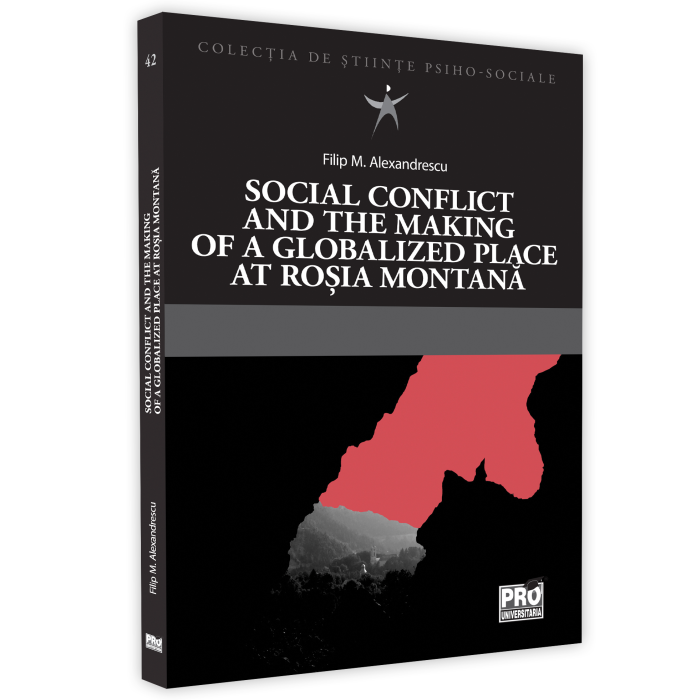
Social conflict and the making of a globalized place at Rosia Montana
43,00 RON
Cel mai mic preț din ultimele 30 de zile: 43,00 RON
Indisponibil
Livrare gratuită peste 200 RON
Curier 24-48h
Comandă prin telefon
Rapid
Livrare în două zile lucrătoare
Maxim 48h
Povestea din spatele paginii
Read the book online: Click HERE!
The book provides a theoretically informed case study on the transformation of the experience of place in the two decades old conflict over the Roșia Montana mine in Romania. First, the case study is set within a political economy approach of mining places before and during globalization. The second theoretical approach used to illuminate the transformations of place is anthropological and draws on Clifford Geertz’s (1979) distinction between experience-nearness and experience-distance. Both these theoretical strands are employed to explain transformations in the experience of place and the subsequent making of a globalized place. In contrast to the majority of social-scientific research on Roșia Montana, which has used this case to illustrate broader arguments in political ecology or environmental justice (e.g. moral economies, degrowth or transnationalism), this book explores the shifting discourses and practices of various local and extra-local actors and how these have shaped the meanings of this place. Without claiming to be impartial, the book offers a critical interpretation of both corporate and social movement discourses as they shape the experience of place. The arguments are fleshed out using extensive empirical material (66 individual respondents being mentioned in the analysis) and contextualized interpretations of their views. The book concludes by arguing that Roșia Montana can offer a contemporary version of what Doreen Massey (1991) has called a ‘progressive notion of place’, one which will increasingly render extractive projects, both in Romania and worldwide, as critical nodes in a web of socio-ecological struggles and open-ended change.
Bibliography
Academy of Economic Studies, (2003), The Report of the Academy of Economic Studies regarding the economic, financial, social, environmental and sustainability of the Rosia Montana mining project. Retrieved March 5,
2004 (www.acad.ro/rosia_montana/doc.../raport_ase_final_2.doc).
AFP (Agence France-Presse), (February 11, 2000), “Romanian cyanide spill a
'European catastrophe'”. Retrieved May 11, 2019 (http://www.greenspun.com/ bboard/q-and-a-fetch- msg.tcl?msg_id=002XQ9).
Alexandrescu, Filip and Bernd Baldus, (2017), “Chapter 13: Escaping the Iron Cage of Environmental Rationalizations: Microsocial Decision-Making in Environmental Conflicts”. Pp. 206-223 in Microsociological Perspectives for Environmental Sociology, edited by Bradley H. Brewster and Antony J. Puddephatt. London, New York: Routledge.
Alexandrescu, Filip, (2013), “Mediated risks: the Roșia Montana displacement and a new perspective on the IRR model.” Canadian Journal of Development Studies 34(4): 498–517.
Alexandrescu, Filip, (2012), Human Agency in the Interstices of Structure: Choice and Contingency in the Conflict over Rosia Montana, Romania. PhD dissertation. The University of Toronto, Canada. (http://hdl.handle.net /1807/32297).
Alexandrescu, Filip, 2011. “Gold and Displacement in Eastern Europe: Risks and Uncertainty at Rosia Montana”, Revista Romana de Sociologie [Romanian Review of Sociology] XXII (1-2), 78 - 107.
Alexandrescu, Filip M., (2004), “The Social Consequences of the Rosia
Montana Mining Project: Between Impoverishment Risks and Corporate
Responsibility.” Unpublished master’s thesis, Lund University.
Ali, Saleem H. and Larissa Behrendt, (2001), “Mining & Indigenous Rights: the emergence of a global social movement.” Cultural Survival Quarterly 25.1. Retrieved 23 March 2009, (http://www.culturalsurvival. org/ourpublications/csq/article/mining-indigenous-rights-emergence-a- global-social-movement).
Ali, Saleem H. and Andrew Singh Grewal, (2006), “The Ecology and Economy of Indigenous Resistance: Divergent Perspectives on Mining in New Caledonia.” The Contemporary Pacific 18(2): 361–392.
Anghel, Ionut, (2013), “Not so local as it seems. Transnational protests against
the gold mining project at Rosia Montana.” Pp. 95-106 in The European Culture for Human Rights: The Right to Happiness, edited by Elena Zamfir & Filomena Maggino. Cambridge: Cambridge Scholars Publishing.
Antypas, Alexios, and S. Stec, (2003), “Towards a Liability Regime for Damages to Transboundary Waters by Industrial Accidents: A New Protocol in the UNECE Region.” Environmental Law and Management
15(5): 295-300.
Arnold, David. 1996. The Problem of Nature: Environment, Culture and European
Expansion. Cambridge, MA: Blackwell.
Arsel, Murat, (2005), “The Bergama Imbroglio.” Pp. 263–275 in Environmentalism in Turkey: Between Democracy and Development, edited by Fikret Adaman and Murat Arsel. Aldershot, Burlington: Ashgate.
Argeseanu Cunningham, Solveig, (2005), “Incident, accident, catastrophe:
Cyanide on the Danube.” Disasters 29(2): 99-128.
Badica, Petre, (June 2, 2009), “Zece super-proiecte care ar putea reinvia economia Romaniei.” [“Ten Super Projects that could Revitalize the Romanian Economy”]. Romania Libera. Retrieved: June 3, 2009. (http://www.romanialibera.ro/a155689/zece-proiecte-care-ar-putea- relansa-economia-romaniei.html).
Baldus, Bernd, (2016), The Origins of Inequality in Human Society. New York: Routledge.
Balica, Ecaterina and Anca Velicu, (2005), "Consecințele sociale ale procesului de stramutare și relocare a populației din Roșia Montana" ["The Social Consequences of the Resettlement and Relocation Process of the Population from Roșia Montana"] Academica 34 (171): 64 - 68.
Ballard, Chris and Glenn Banks, (2003), “Resource Wars: The Anthropology of
Mining.” Annual Review of Anthropology 32: 287–313
Ban, Cornel and Anca Romantan, (2007), “Just Greens? Anti Gold Mining
Protest in Roșia Montana.” (unpublished manuscript).
Ban, Cornel and Anca Romantan, (2008), “Fuzzy Europeanization: The Role of the EU in Civic Opposition to Gold Mining in Romania”. Unpublished manuscript. Amherst, Massachusetts: University of Massachusetts at Amherst.
Banches, Ovidiu, (December 31, 2009), “Cazul Roșia Montana se tranșeaza in
CSAT fara UDMR.” [“The Rosia Montana Case will be decided in the
CSAT (Supreme Council of National Defence“]. Ziua. Retrieved: May 11,
2019 ( http://www.ziua.ro/display.php?data=2009-12-31&id=263666). Bankwatch, (2002), “Roșia Montana gold mine: a future predictable
catastrophe”. Retrieved May 2, 2011 (http://bankwatch.org /documents
/ rosiamontana.pdf).
Baron, Mircea, (2006), Din Istoria Mineritului Aurifer in Romania 1918 – 1945
[The History of Gold Mining in Romania 1918-1948]. Petrosani: Universitas. Barry, John, (2007), Environment and Social Theory. London & New York:
Routledge.
Bauman, Zygmunt, (1998), Globalization: The Human Consequences. New
York: Columbia University Press.
Bauman, Zygmunt, (2001), Community: Seeking Safety in an Insecure World.
Cambridge: Polity.
Baxter, Jamie, John Eyles and Susan Elliott, (1999), “ ‘Something Happened’: The Relevance of the Risk Society for Describing the Siting Process for a Municipal Landfill.” Geografiska Annaler. Series B, Human Geography
81(2): 91 – 109.
Beattie, Alan, McAleer, Phelim, (2002, October 29), “World Bank arm denies green claims” [London edition]. Financial Times, p. 13. Retrieved September 11, 2008, from ABI/INFORM Global database. (Document ID:
225282961).
Bebbington, Anthony and Denise Humphreys Bebbington, (2018), “Mining, movements and sustainable development: Concepts for a framework”. Sustainable Development 26: 441–449. https://doi.org/10.1002/sd.1888.
Beck, Ulrich, (1992), Risk society: Towards a New Modernity. London: Sage. Bejan, Raluca, Peter Murvai, Iulia Mihaila and Mirela Cherciov, (2015),
“Transnational responses to global capitalism: The case study of the Rosia Montana campaign.” Transnational Social Review: A Social Work Journal 5(2): 199 – 207.
Bell, Colin and Howard Newby, (1971), Community Studies: An introduction to the sociology of the local community. London: George Allen and Unwin.
Bell, Michael M., (2011), An Invitation to Environmental Sociology. Los Angeles, London: Sage.
Bell, Michael M., (1994), Childerley: Nature and Morality in a Country Village.
Chicago and London: University of Chicago Press.
Bingman, Mary B., (1993), “Stopping the Bulldozers: What difference did it make?” Pp. 17 – 30 in Fighting Back in Appalachia: Traditions of Resistance and Challenge, edited by Stephen L. Fisher. Philadelphia: Temple University Press.
Borchgrevink, Axel, (2003), “Silencing language: Of anthropologists and interpreters.” Ethnography 4(1): 95–121.
Branea. Cristian, (2015), “Models of Contention and Participation of Civil Society in Rosia Montana Environmental Conflict.” Romanian Journal of Society and Politics 8(2): 87-114.
Bullard, Robert, (1990), Dumping in Dixie: Race, Class, and Environmental
Quality. Westview Press.
Bulmer, Martin, I.A., (1975), “Sociological Models of the Mining Community”.
Sociological Review 23: 61 - 92.
Burawoy, Michael, (1998), “The Extended Case Method.” Sociological Theory
16(1): 4-33.
Burch, William, (1976), “The Peregrine Falcon and the Urban Poor: Some Sociological Interrelations.” pp. 308 – 316 in Human Ecology: An Environmental Approach, edited by Peter J. Richerson and James McEvoy. North Scituate, Mass.: Duxbury Press.
Burja, Vasile and Silvia–Stefania Mihalache, (2010), “Corporate Social Responsibility. Example Rosia Montana Gold Corporation”. Annales Universitatis Apulensis Series Oeconomica, 12(2): 523 – 532.
Bury, Jeffrey and Adam Kolff, (2002), “Livelihoods, Mining and Peasant
Protests in the Peruvian Andes.” Journal of Latin American Geography
1(1): 3 – 19.
Buțiu, Calina A and Mihai Pascaru, (2009), Sustainable Development and Concentric public participation: The case of the Rosia Montana Gold Corporation mining project. Paper presented at International U.A.B. – B.EN.A workshop „Management and Sustainable Protection of Environment”, Alba Iulia, Romania, May 6 -7, 2009.
Buttel, Frederick H., (1996), “Environmental and Resource Sociology: Theoretical Issues and Opportunities for Synthesis.” Rural Sociology
61(1): 56 – 76.
Buttel, Frederick and Taylor, Peter, (1994), “Environmental Sociology and Global Environmental Change: A Critical Assessment.” Pp. 228 – 255 in Social Theory and the Global Environment, edited by Michael Redclift and Ted Benton. London and New York: Routledge.
Buza, Mircea, Levente Dimen, Grigor Pop and David Turnock, (2001), “Environmental protection in the Apuseni Mountains: The role of Environmental Non-Governmental Organisations (ENGOs)”. GeoJournal
54: 631–653.
Buzoianu, Catalin and Sebastian Țoc, (2013), “Misunderstanding opportunities: (post) resettlement issues in the Recea neighbourhood of Alba Iulia.” Journal of Comparative Research in Anthropology and Sociology 4(1):21-40. Carson, Dean B and Andreas Koch, (2013), “Divining the local: Mobility, scale and fragmented development.” Local Economy: The Journal of the Local
Economy Policy Unit 28(3): 304-319.
Casey, Douglas, (2006), “The Casey Files: A Case Study in Political Risk and How to Profit from It.” The International Speculator, September 16. Retrieved April 18, 2007 (http://www.321gold.com/editorials/casey/ casey091606.html).
Castells, Manuel, (2000), The Rise of the Network Society. Cambridge, MA: Blackwell.
Catton, William, (1982), Overshoot: The Ecological Basis of Revolutionary
Change. Urbana, Chicago, London: University of Illinois Press.
Cernea, Michael M., (2008), “Compensation and Investment in Resettlement: Theory, Practice, Pitfalls, and Needed Policy Reform”. Pp. 15 - 98 in Can Compensation Prevent Impoverishment: Reforming Resettlement through Investments and Benefit-Sharing, edited by Michael M. Cernea and Hari M. Mathur. Oxford, New York, Toronto: Oxford University Press.
Cernea, Michael M., (2003), “Stramutarile din Apuseni la ora adevarului.“ [“The Truth about the Resettlement of the Apuseni Mountains”] Formula As 582, September 15-21. Retrieved July 6, 2011. (http://www.rosiamontana.org
/documents/english/press/formulaasresettl.htm).
Cernea, Michael M., (2000), “Risks, Safeguards, and Reconstruction: A Model for Population Displacement and Resettlement” In Risks and Reconstruction: Resettlers' and Refugees' Experiences, edited by M. Cernea and C. McDowell. Washington D.C.: World Bank.
Cernea, Michael M., (1997), "The Risks and Reconstruction Model for
Resettling Displaced Populations." World Development 25(10): 1569-87. Cernea, Michael M., (1996), “When Some Share the Gains and Others Share
the Pains”: Foreword to the volume on Involuntary Displacement in Dam Projects, edited by A.B. Ota and Anita Agnihotri. Prachi Prakashan: New Delhi, pp. 1-10.
Cernea, Michael M., (1995), “Eight Main Risks: Impoverishment and Social Justice in Resettlement”. Environment Department, World Bank. Washington D.C. ESSD, Processed.
Cernea, Michael M., (1990), “Poverty Risks from Population Displacement in Water Resources Development”. Cambridge, MA: Harvard Institute for International Development.
Cernea, Michael M. (Ed.), (1991), Putting People First: Sociological Variables in
Rural Development. Washington, D.C.: World Bank.
Cernea, Michael M. and Julie K. Maldonado, (2018), Challenging the Prevailing Paradigm of Displacement and Resettlement: Risks, Impoverishment, Legacies, Solutions. London, Routledge.
Chiper, Sorina, (2012), “Rosia Montana and Its Publics: Governance and
Participatory Democracy at Community and Corporate Level.” Argumentum: Journal of the Seminar of Discursive Logic, Argumentation Theory and Rhetoric 10(1): 82 – 105.
Clifford, James, (2004), “Looking Several Ways: Anthropology and Native
Heritage in Alaska.” Current Anthropology 45(1): 5 – 30.
Çoban, Aykut, (2004), “Community-based Ecological Resistance: The Bergama
Movement in Turkey” Environmental Politics 13(2): 438 – 460.
Colley, Peter, (2002), “Political Economy of Mining.” Pp. 19 – 36 in Moving Mountains: Communities Confront Mining and Globalization, edited by Geoff Evans, James Goodman and Nina Lansbury. London and New York: Zed Books.
Colquhoun, Robert, (1996), “The art of social conjecture: remembering
Bertrand de Jouvenel.” History of the Human Sciences 9(1): 27 – 42. Conde, Marta, (2017), “Resistance to Mining. A Review.” Ecological Economics
132: 80 – 90.
Conklin, Beth A. and Laura R. Graham, (1995), “The Shifting Middle Ground: Amazonian Indians and Eco-Politics.” American Anthropologist 97(4):
695-710.
Costi, Alberto, (2003), “Environmental Protection, Economic Growth and Environmental Justice: Are They Compatible in Central and Eastern Europe?” Pp. 289 – 309 in Just Sustainabilities: Development in an Unequal World, edited by Julian Agyeman, Robert D. Bullard and Bod Evans. London: Earthscan.
Cresswell, Tim, (2004), Place: A Short Introduction. Malden, MA; Oxford: Blackwell. Cronon, William, (1992), “Konnecott Journey: The Paths out of Town.” Pp. 28 – 51
in Under an Open Sky: Rethinking America’s Western Past, edited by W. Cronon, G. Miles and J. Gitlin. New York, London: W. W. Norton.
Daly, Herman, (2008), Ecological Economics and Sustainable Development, Selected Essays of Herman Daly. Cheltenham, Northampton: Edward Elgar.
Damsell, Keith, (2000), “Gabriel's Romanian mining plans face chance of ending in ruins: Archaeological protest.” National Post. Don Mills, Ont: Apr 6, 2000. p. C.3
Danielson, V., (2005), “Carpathian Arc key to Europe's mining renaissance.”
The Northern Miner (Mar 4-Mar 10) 91(2): C1 – C10.
Dasmann, Raymond, (1988), “Toward a Biosphere Consciousness” Pp. 277-
288 in The Ends of the Earth: Perspectives on modern environmental history, edited by Donald Worster. New York, Sydney: Cambridge University Press.
Dawson, Michael, (2017), “Rosia Montana: The Road to World Heritage
Status.” The Historic Environment: Policy & Practice 8(1): 25-47.
De Echave, José, (2005), “Peruvian peasants confront the mining industry.”
Socialism and Democracy 19(3): 117 – 127.
Dirlik, Arif, (2002), “Women and the Politics of Place: A comment” Development
45(1): 14 – 18.
Dordea, Ioan, (2003), “Der historische Bergbau in Rosia Montana und seine Sozialeinrichtung im 19. Jahrhundert.” [“Historical mining in Rosia Montana and its Social Facilities”. Der Anschnitt: Zeitschrift für Kunst und Kultur im Bergbau [Der Anschnitt: Review of Art and Culture in Mining] 55(6): 274 – 287.
Dow, Grove, (1920), Introduction to the Principles of Sociology. Waco: Baylor
University Press.
Downing, Theodore E., (2002), “Avoiding New Poverty: Mining-Induced Displacement and Resettlement.” Retrieved: November 15, 2004 (www.iied.org/mmsd/mmsd_pdfs/058_ downing.pdf).
Dulamița, Ionuț, (2010), “Stephanie Roth. Activista care se bate pentru Rosia Montana.” 155 March 25, 2010. In Afara Cutiei [Think Outside the Box]. Retrieved June 1, 2019. (https://www.totb.ro/stephanie-roth-activista- care-se-bate-pentru-rosia-montana-2/).
Dunlap, Riley E., & Richard P. Gale, (1972), “Politics and ecology: A political profile of student ecoactivists”. Youth and Society, 3: 379-397.
Dwivedi, Ranjit, (2002), Models and methods in development–induced displacement. Development and Change, 33(4): 709-732.
Dwivedi, Ranjit, (1999), “Displacement, Risks and Resistance: Local Perceptions
and Actions in the Sardar Sarovar.” Development and Change 30: 43-78. Ecological University, (2003), Opportunities for Economic Dev
Format · tipar
Cartonată
Academic (17 × 24 cm)
Limbă
Română
Identificatori
ISBN
978-606-26-1193-4
Editură
2020, 2020-2024, 2020-2025, 2015-2026
31-05-2020
Istoricul tău