
Indisponibil
Analiza avansata a datelor in stiintele sociale. Studiu de caz: constrangeri si consecinte ale invatamantului online
Analiza avansata a datelor in stiintele sociale. Studiu de caz: constrangeri si consecinte ale invatamantului online
28,54 RON
Cel mai mic preț din ultimele 30 de zile: 28,54 RON
În stoc
Livrare gratuită peste 200 RON
Curier 24-48h
Comandă prin telefon
Rapid
Livrare în două zile lucrătoare
Maxim 48h
Povestea din spatele paginii
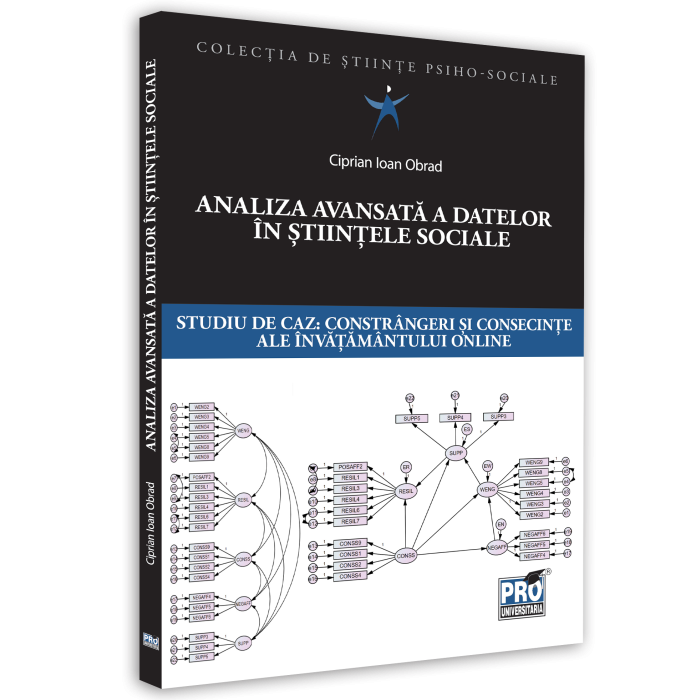
Cartea se adreseaza in mod special celor care studiaza stiintele socio-umane, care pe parcursul facultatii sau studiilor masterale doresc sa dobandeasca abilitati de cercetare si sunt pusi in fata provocarii de natura practica de a gestiona o cercetare empirica, pornind de la tehnici avansate de analiza multivariata, precum analiza factoriala exploratorie (EFA), analiza factoriala confirmatorie (CFA), analiza de cale (PATH) sau modelarea prin ecuatii structurale (SEM).
Am considerat necesara aparitia unui tratat care sa exemplifice toate secventele si operatiile necesare de parcurs pentru astfel de analize avansate, dar si exigentele unor prezentari/redactari de rapoarte utile in scrierea de articole stiintifice. Demersul propus a implicat atat probleme de continut, de metodologie, dar si de forma. Am incercat sa nu uitam nici de aspectele de evidentiere si valorificare a muncii de cercetare, ca produs final.
Bibliografie:
Agirreazkuenaga, L., Education for Agenda 2030: What Direction do We Want to Take Going Forward? Sustainability 2020, 12, 2035, doi: 10.3390/su12052035 [Google Scholar] [CrossRef] (70).
Akgül, Y. Structural Equation Modeling Approaches to E-Service Adoption, Publisher: IGI Global, 2019; pp. 1-359, ISBN-13: 978-1522580157. (82).
Allan, J.F.; McKenna, J.; Dominey, S., Degrees of resilience: Profiling psychological resilience and prospective academic achievement in university inductees. Br. J. Guid. Couns. 2014, 42, 9-25. [Google Scholar] [CrossRef] (45).
Altunel, M.C.; Omer E.K.; Cankir, B., The Effect of Job Resources on Work Engagement: A Study on Academicians in Turkey. Educational Sciences: Theory and Practice 2015, 15, 409-417, doi: 10.12738/estp.2015.2.2349. [Google Scholar] [CrossRef] (67).
Amponsah, K.D.; Adasi, G.S.; Mohammed, S.M.; Ampadu, E.; Okrah, A.K., Stressors and coping strategies: The case of teacher education students at University of Ghana. Cogent Education 2020, 7, doi: 10.1080/2331186X.2020.1727666. [Google Scholar] [CrossRef] (46).
Asif, T.; Guangming, O.; Haider, M.A.; Colomer, J.; Kayani, S.; Amin, N., Moral Education for Sustainable Development: Comparison of University Teachers’ Perceptions in China and Pakistan. Sustainability 2020, 12, 3014, doi: 10.3390/su12073014 [Google Scholar] [CrossRef] (76).
Atkinson, T.M. Using Confirmatory Factor Analysis to Evaluate Construct Validity of the Brief Pain Inventory (BPI), J Pain Symptom Manage 2011, 41, 558-565, doi: 10.1016/ j.jpainsymman.2010.05.008. [Google Scholar] (90).
Avey, J.B.; Reichard, R.J.; Luthans, F.; Mhatre, K.H., Meta-analysis of the impact of positive psychological capital on employee attitudes, behaviors, and performance. Human Resource Development Quarterly 2011, 22, 127-152, doi: 10.1002/hrdq. 20070. [Google Scholar] [CrossRef] (38).
Azer S.A. The qualities of a good teacher: how can they be acquired and sustained?. Journal of the Royal Society of Medicine 2005, 98(2), 67-69, doi: 10.1258/jrsm.98.2.67 [Google Scholar] [CrossRef] (75).
AHolfelder, T.; Joiner, T.A.; Stanton, P., Factors affecting the job stress and job satisfaction of Australian nurses: Implications for recruitment and retention, Contemporary Nurse 2004, 17, 293-304, doi: 10.5172/conu.17.3.293. [Google Scholar] [CrossRef] (69).
Biggs, A., Brough, P.; Drummond, S., Lazarus and Folkman's Psychological Stress and Coping Theory. In Handbook of Stress and Health, Cooper, C.L.; Quick, J.C., Eds.; Publisher: Wiley, 2017; pp. 349-364, ISBN: 978-1-118-99377-4 (21).
Bitsika, V.; Sharpley, C.F.; Bell, R., The Buffering Effect of Resilience upon Stress, Anxiety and Depression in Parents of a Child with an Autism Spectrum Disorder. J Dev Phys Disabil 2013, 25, 533-543, doi: 10.1007/s10882-013-9333-5. [Google Scholar] [CrossRef] (41).
Bollen, K.A., (1989), Structural equations with latent variables. Wiley-Interscience (115).
Borman G.D.; Overman L.T., Academic resilience in mathematics among poor and minority students. Elem Sch J 2004, 104, 177-195, doi: 10.1086/499748. [Google Scholar] [CrossRef] (44).
Braeken, J.; van Assen, M.A.L.M., An empirical Kaiser criterion. Psychological Methods 2017, 22, 450-466, doi: 10.1037/ met0000074 (87).
Brown, T.A. Confirmatory Factor Analysis for applied Research. Publication: The Guilford Press, New York, 2006; pp.72, ISBN: 978-1-59385-274-0 (91).
Byrne, B.M. Structural equation modeling with AMOS: Basic concepts, applications, and programming. Publisher: Routledge, New York, 2010; ISBN: 978-0-8058-6372-7 (99).
Carbureanu, M., (2010), O metoda de analiza factoriala aplicata in domeniul dezvoltarii, in Analele Universitatii „Constantin Brancusi” din Targu Jiu, Seria Economie, nr. 1 (118).
Carver, C.S., You want to measure coping but your protocol’ too long: Consider the brief cope. Int. J. Behav. Med 1997, 4, doi: 10. 1207/s15327558ijbm0401_6. [Google Scholar] [CrossRef] (50)
Cattell, R.B., The Scree Plot Test for the Number of Factors. Multivariate Behavioral Research 1966, 1, 140-161, doi: 10.1207/ s15327906mbr0102_10. [Google Scholar] [CrossRef] (85).
Chan, E.S.S.; Ho, S.K.; Ip, F F.L.; Wong, M.W.Y., Self-Efficacy, Work Engagement, and Job Satisfaction Among Teaching Assistants in Hong Kong’s Inclusive Education. SAGE Open, 2020, 10(3), doi: 10.1177/2158244020941008 [Google Scholar] [CrossRef] (79).
Cheryl, J.T.; Cary L.C., Mental health, job satisfaction and occupational stress among UK teachers. Work & Stress 1993, 7, 203-219, doi: 10.1080/02678379308257062. [Google Scholar] [CrossRef] (7).
Chesney, M.A.; Neilands, T.B.; Chambers, D.B.; Taylor, J.M.; Folkman, S., A validity and reliability study of the coping self-efficacy scale. British Journal of Health Psychology 2006, 11, 421-437, doi: 10.1348/135910705X53155. [Google Scholar] [CrossRef] (51).
Child, D., The Essentials of Factor Analysis. 3rd edition, Publisher Continuum, New York, 2006; ISBN-13: 978-0826480002 (84).
Chisingui, A.V.; Costa, N., Teacher Education and Sustainable Development Goals: A Case Study with Future Biology Teachers in an Angolan Higher Education Institution. Sustainability 2020, 12, 3344, doi: 10.3390/su12083344 [Google Scholar] [CrossRef] (74).
Clocotici, V., Stan, A., (2000), Statistica aplicata in Psihologie, Editura Polirom, ISBN: 973-683-577-4 (121).
Cooper, C.; Travers, C. Teachers Under Pressure: Stress in the Teaching Profession. Publisher: Routledge, UK, 1995; pp.159, ISBN 0-415-09484-4 [CrossRef] (12).
Costello, A.B.; Osborne, J., Best Practices in Exploratory Factor Analysis: Four Recommendations for Getting the Most From Your Analysis. Practical Assessment. Research & Evaluation 2005, 10, 1-9 [Google Scholar] (88).
Curran, P.J., West, S., & Finch, J.F., The Robustness of Test Statistics to Nonnormality and Specification Error in Confirmatory Factor Analysis. Psychological Methods 1996, 1,16-29, doi: 10.1037/ 1082-989X.1.1.16 [Google Scholar] [CrossRef] (100).
De Carlo, A.; Girardi, D.; Falco, A.; Dal Corso, L.; Di Sipio, A., When Does Work Interfere With Teachers’ Private Life? An Application of the Job Demands-Resources Model. Front. Psychol 2019, 10, 1-13, doi: 10.3389/fpsyg.2019.01121. [Google Scholar] [CrossRef] (4).
Delcea, C., Bradea, I-A., Modelarea prin ecuatii structurale in economie, Editura Universitara, 2017, ISBN 978-606-28-0560-9 (113).
DeVellis, R.F., Scale development: Theory and applications, 3rd edition. Publisher: Sage Publications, London, 2012; pp. 95-96, ISBN-13: 9781412980449 (94).
Du, J.; Huang, J.; An, Y., Xu, W., The relationship between stress and negative emotion: The Mediating role of rumination. Clin Res Trials 2018, 4, 1-5, doi: 10.15761/CRT.1000208. [Google Scholar] (24).
EUROSTAT Government expenditure on education, available online at: https://ec.europa.eu/eurostat/statistics-explained/index. php/Government_expenditure_on_education, (accessed on 11 August 2020) (105).
Fabrigar, L., Wegener, D.T., MacCallum, R., Strahan, E.J., (1999), Evaluating the use of exploratory factor analysis in psychological research, in Psychological Methods 4(3):272 (119).
Field, A., Discovering Statistics Using SPSS. 3rd edition, Publisher: SAGE Publication, London, 2009; ISBN-13: 978-1847879073 (86).
Folkman, S., The case for positive emotions in the stress process. Anxiety, Stress & Coping 2008, 21, 3-14, doi:10.1080/ 10615800701740457. [Google Scholar] [CrossRef] (31).
Folkman, S.; Moskowitz, J. T. Stress, Positive Emotion, and Coping. Current Directions in Psychological Science 2000, 9, 115-118, doi:10.1111/1467-8721.00073. [Google Scholar][CrossRef] (30).
Gaskin, J.; Lim, J., Pattern Matrix Model Buider, AMOS 23Plugin. Gaskination's StatWiki; 2016 (89).
George, D., & Mallery, P., (2003), SPSS for Windows Step by Step: A Simple Guide and Reference. 11.0 Update (4th ed.). Boston: Allyn & Bacon (112).
Goodwin, R., Why I study relationships and culture. The Psychologist, 2005, 18 (104).
Griffith, J.; Steptoe, A.; Cropley, M., An investigation of coping strategies associated with job stress in teachers. The British journal of educational psychology 2000, 69, 517-31, doi: 10.1348/000709999157879. [Google Scholar] [CrossRef] (55).
Gruenert, S.; Whitaker, T., School culture rewired: how to define, assess, and transform it. Publisher: ASCD, Alexandria, Virginia USA, 2015; ISBN: 978-1-4166-1990-1 (58).
Hair Jr, J.F.; Hult, G.T.M.; Ringle, C.; Sarstedt, M., A primer on partial least squares structural equation modeling (PLS-SEM). Publisher: Sage Publications, 2013; ISBN: 978-4522-1744-4 (97).
Hair Jr., J.F. et al., Multivariate Data Analysis with Readings. Publisher: Englewood Cliffs, NJ: Prentice-Hall, 1998; ISBN: 978-0-138-94858-0 (92).
Hair, J.F.; Black, W.C.; Babin, B.J.; Anderson, R.E.; Tatham, R.L., Multivariate data analysis. 6th edition. Publisher: Pearson, Upper Saddle River, New Jersery, SUA, 2005; ISBN-13: 978-0130329295 (93).
Hair, J.F.; Black, W.; Babin, B.; Anderson, R., Multivariate Data Analysis: A Global Perspective, 7th edition, Publisher: Pearson, London, 2010; ISBN: 978-3-030-06030-5 (83).
Hair, J.; Black, W.; Babin, B.; Anderson, R., Multivariate data analysis. Publisher: Prentice Hall, London, 2009; ISBN-13: 978-0138132637 (98).
Hakanen, J.; Demerouti, E.; Xanthopoulou, D., Job Resources Boost Work Engagement, Particularly When Job Demands Are High. Journal of Educational Psychology 2007, 99, 274-284, doi: 10.1037/0022-0663.99.2.274. [Google Scholar] [CrossRef] (53).
Hamilton, John R., and Tee, Singwhat, (2015), Presenting SEM models: journal and conference considerations. In: Proceedings of the 20th Asia Pacific Decision Sciences Institute Conference. 201. pp. 1-8. From: APDSI 2015: 20th Asia Pacific Decision Sciences Institute Conference, 19-24 July 2015, Hong Kong, China (114).
Harmsen, R.; Helms-Lorenz, M.; Maulana, R.; van Veen. K., The relationship between beginning teachers’ stress causes, stress responses, teaching behaviour and attrition. Teachers and Teaching, 2018, 24:6, 626-643, doi: 10.1080/13540602. 2018.1465404 [Google Scholar] [CrossRef] (78).
Holfelder, A., Towards a sustainable future with education? Sustain Sci 2019, 14, 943–952, doi: 10.1007/s11625-019-00682-z [Google Scholar] [CrossRef] (71).
Hu, J.; Gruber, K.J., Positive and negative affect and health functioning indicators among older adults with chronic illnesses. Issues in mental health nursing 2008, 29, 895–911, doi: 10.1080/ 01612840802182938. [Google Scholar] [CrossRef] (25).
Hu, L.; Bentler, P.M., Cutoff criteria for fit indexes in covariance structure analysis: Conventional criteria versus new alternatives. Structural Equation Modeling 1999, 6, 1–55, doi: 10.1080/10705519909540118. [Google Scholar] (102).
Hutri, M.,; Lindeman, M., The Role of Stress and Negative Emotions in an Occupational Crisis. Journal of Career Development 2002, 29, 19–36, doi: 10.1023/ 1016547718122. [Google Scholar] [CrossRef] (23).
Hyseni Duraku, Z.; Hoxha, L., Self-esteem, study skills, self-concept, social support, psychological distress, and coping mechanism effects on test anxiety and academic performance. Health Psychology Open 2018, 1-9, doi: 10.1177/205510291879 9963 [Google Scholar] [CrossRef] (77).
Kahn, W.A., To Be Fully There: Psychological Presence at Work. Human Relations 1992, 45, 321–349, doi: 10.1177/0018726 79204500402. [Google Scholar] [CrossRef] (66).
Kaiser, H.F., An index of factorial simplicity. Psychometrika 1974, 39, 31–36 (81).
Kannan, J.; Miller, J.L., The Positive Role of Negative Emotions: Fear, Anxiety, Conflict and Resistance as Productive Experiences in Academic Study and in the Emergence of Learner Autonomy. International Journal of Teaching and Learning in Higher Education 2009, 20, 144-154 [Google Scholar] (28).
Kašpárková, L.; Vaculík, M.; Procházka, J.; Schaufeli W.B., Why resilient workers perform better: The roles of job satisfaction and work engagement. Journal of Workplace Behavioral Health 2018, 33, 43-62, doi: 10.1080/15555240.2018.1441719. [Google Scholar] [CrossRef] (39).
Kaur, M.; Kaur, A., Resilience And Growth Initiative: Buffer Against Acculturation Stress. Int J Recent Sci Res 2017, 8, 21126-21133, doi: 10.24327/ijrsr.2017.0810.1017. [CrossRef] (43).
Klassen, R.; Chiu, M.M., Effects on Teachers' Self-Efficacy and Job Satisfaction: Teacher Gender, Years of Experience, and Job Stress. Journal of Educational Psychology 2010, 102, 741-756, doi: 10.1037/a0019237. [Google Scholar] [CrossRef] (16).
Kline R.B., Principle and practice of structural equation modeling, 3rd edition. Publisher: Guilford Press, New York, 2011; pp. 54, ISBN: 978-1-60623-877-6 (101).
Kuiper, N.A.; Olinger, L.J.; Martin, R.A., Dysfunctional attitudes, stress, and negative emotions. Cogn Ther Res 1988, 12, 533-547, doi: 10.1006/1994.1018. [Google Scholar] [CrossRef] (22).
Kuok, A.C.H.; Taormina, R.J., Work Engagement: Evolution of the Concept and a New Inventory. Psychological Thought 2017, 10, 262-287, doi: 10.5964/psyct.v10i2.236. [Google Scholar] [CrossRef] (62).
Kyriacou, C. Teacher stress: From prevalence to resilience. Handbook of Stress in the Occupations. Publisher: Edward Edgar Publishing Limited, UK, 2011; pp. 161-173, ISBN: 978 0 85793 114 6 (13).
Langelaan, S.; Bakker, A.B.; van Doornen, L.J.P.; Schaufeli, W.B, Burnout and work engagement: Do individual differences make a difference? Personality and Individual Differences 2006, 40, 521–532, doi: 10.1016/j.paid.2005.07.009. [Google Scholar] [CrossRef] (65).
Lee, J.S.; Ahn, Y.S.; Jeong, K.S.; Chae, J.H.; Choi, K.S., Resilience buffers the impact of traumatic events on the development of PTSD symptoms in firefighters. Journal of affective disorders 2014, 162, 128-33, doi: 10.1016/j.jad.2014.02.031. [Google Scholar] [CrossRef] (42).
Levenstein, S.; Prantera, C.; Varvo, V.; Scribano, M.L. & Berto, E.; Luzi, C.; Andreoli, A., Development of the Perceived Stress Questionnaire: A new tool for Psychosomatic Research. Journal of psychosomatic research 1993, 37, 19-32, doi: 10.1016/ 0022-3999(93)90120-5. [Google Scholar] [CrossRef] (20).
Levine, E.L.; Xu, X.; Yang, L.Q.; Ispas, D.; Pitariu, H.D.; Bian, R.; Musat, S., Cross-national explorations of the impact of affect at work using the State-Trait Emotion Measure: a coordinated series of studies in the United States, China, and Romania. Human Performance 2011, 24, 405–442, doi: 10.1080/ 08959285.2011.614302. [Google Scholar] [CrossRef] (35).
Levine, T.H., Tools for the Study and Design of Collaborative Teacher Learning: The Affordances of Different Conceptions of Teacher Community and Activity Theory. Teacher Education Quarterly 2010, 37, 109-130 [Google Scholar] (57).
Lleras, C., (2005), Path Analysis, in Enciclopedia of Social Measurement, pg. 25-30, https://doi.org/10.1016/B0-12-369398-5/00483-7 (122).
Luthar, S.S., Cicchetti, D.; Becker, B., The construct of resilience. A critical evaluation and guidelines for future work. Child Development 2000, 71, 543–562, doi: 10.1111/1467-8624.00164. [Google Scholar] [CrossRef] (36).
Martínez, J.P.; Méndez I.; Ruiz-Esteban, C.; Fernández-Sogorb, A.; García-Fernández, J.M., Profiles of Burnout, Coping Strategies and Depressive Symptomatology. Front. Psychol 2020, 11, 591, doi: 10.3389/fpsyg.2020.00591. [Google Scholar] [CrossRef] (47).
Maslach, C.; Jackson, S.E., The measurement of experienced burnout. Journal of Organizational Behavior 1981, 2, 99-113, doi: 10.1002/job.4030020205. [Google Scholar] [CrossRef] (14).
Maslach, C.; Jackson, S.; Leiter, M., The Maslach Burnout Inventory Manual. In Evaluating Stress: A Book of Resources, Zalaquett, C.P.;Wood. R.J.; Publisher: The Scarecrow Press, 1997; ISBN-13: 978-0810832312 (17).
Maslach, C.; Jackson, S.; Schwab, R., Maslach Burnout Inventory -- Educators Survey (ES). 1997. Available online: https://www.researchgate.net/publication/277816643 (accessed on 7 June 2020) (18).
Masten, A.S.; Best, K.M.; Garmezy, N., Resilience and Development: Contributions from the Study of Children Who Overcome Adversity. Development and Psychopathology 1990, 2, 425-444, doi: 10.1017/S0954579400005812. [Google Scholar] [CrossRef] (37).
Meyer, J.P.; Stanley, D.J.; Herscovitch, L., Topolnytsky, L., Affective, Countinuance, and Normative Commitment to the Organization: A Meta-Analysis of Antecedents, Correlates, and Consequences. Journal of Vocational Behavioral 2002, 61, 20-52, doi: 10.1006/jvbe.2001.1842. [Google Scholar] [CrossRef] (68).
Moreno Fortes, A.; Tian L.; Huebner E.S., Occupational Stress and Employees Complete Mental Health: A Cross-Cultural Empirical Study. Int. J. Environ. Res. Public Health 2020, 17, 3629-3647, doi: 10.3390/ijerph17103629. [Google Scholar] [CrossRef] (15).
Mroczek, D.K.; Kolarz, C.M., The effect of age on positive and negative affect: a developmental perspective on happiness. Journal of personality and social psychology 1998, 75, 1333-1349, doi: 10.1037/0022-3514.75.5.1333. [Google Scholar][CrossRef] (34).
Nicolas, M.; Vachera, P.; Martinent, G.; Mourot, L., Monitoring stress and recovery states: Structural and external stages of the short version of the RESTQ sport in elite swimmers before championships. J Sport Health Sci. 2019, 8, 77-88, doi: 10.1016/j.jshs.2016.03.007. [Google Scholar] [CrossRef] (5).
Organizatia Mondiala a Sanatatii. World Health Organization. Disponibil online: https://www.who.int/occupational_health/ topics/stressatwp/en/ (accesat in 15 iunie 2020) (1).
Osborne, J.W., (2015), What is Rotating in Exploratory Factor Analysis? In in Practical Assessment, Research & Evaluation, vol. 2, nr. 2, 2015, ISSN 1531- 7714 (120).
Pandey, N.K.; Saxena A., Teacher's Occupational Stress: A Review Study in National & International Scenario. International Journal of Organizational Behaviour and Management Perspective 2015, 4, 1533-1538. [Google Scholar] (9).
Pekrun, R.; Perry, R.P., Control-value theory of achievement emotions. In International Handbook of Emotions in Education; Alexander, P.A.; Pekrun, R.; Linnenbrink-Garcia; L.; Eds.; Publisher: Routledge: London, UK, 2014; pp. 120–141, ISBN: 978-0415895026 (32).
Perry Hinton, Isabella McMurray, Charlotte Brownlow, SPSS Explained, Routledge, London, 2004, https://doi.org/ 10.4324/9780203642597 (111).
Pogere, E.; López-Sangil, M.; García-Señorán, M.; González, A., Teachers’ job stressors and coping strategies: Their structural relationships with emotional exhaustion and autonomy support. Teaching and Teac
Format · tipar
Cartonată
Academic (17 × 24 cm)
Limbă
Română
Identificatori
ISBN
978-606-26-1351-8
Editură
2021, 2020-2024, 2020-2025, 2015-2026
01-04-2021
Istoricul tău